Le texte ne s’affiche pas intégralement dans la langue que vous avez sélectionnée ? La Boîte à outils ne cesse d’évoluer, et il semblerait que nous n’ayons pas encore totalement traduit cet article. Contactez-nous si vous avez envie de traduire de nouveaux textes!
En bref
Hanging a banner off a building or structure makes for great media coverage, alerting the broad public to an issue or campaign. It’s also a good way to frame or contextualize an upcoming action.
What better way to air the dirty laundry of an irresponsible institution than to hang a giant banner over its front door? A banner drop can also be an effective way to frame or contextualize an upcoming event or protest (see: PRINCIPLE: Reframe the issue). Banner hangs can also function as public service announcements to alert the public of an injustice or a dangerous situation.
Banner hangs can be as low-tech and low-risk as several bedsheets tied to road overpasses, but the ones that really pack a punch involve large pieces of cloth or netting deployed at great heights, often by experienced climbers.
If it’s worth saying, it’s worth saying loudly!
Regardless of the level of risk or complexity, all effective banner hangs start with a clear goal (you have a goal, right?!), and fall into two broad categories: communicative (concise protest statements), and concrete (blockade elements that directly disrupt business as usual). In 1991, small communities in the Pacific Northwest sought to stop nuclear warships from entering Clatsop County, Oregon, a designated nuclear-free zone on the Columbia River. In a great example of a banner hang with a concrete goal, an enormous net banner was deployed from the Astoria Bridge, affixed below the span where it would be difficult to remove, and weighted by the climbers’ bodies themselves. The action succeeded in delaying the warships’ entrance while educating the area on the issue.
Most banner hangs, however, tend to be communicative. Take, for instance, the banner hung from a crane in downtown Seattle in November 1999 (see: STORY: Battle in Seattle) just before the opening of the World Trade Organization meeting. The banner messaging was as clear as day: an iconic visual of a street sign with arrows pointing in opposite directions: democracy this way, WTO that way. This was a classic “framing action” (see: THEORY: Framing). Hung on the eve of a big summit meeting and a huge protest, the banner made it clear what all the fuss to come was really about: a basic struggle of right and wrong; the People vs. the WTO.
For a successful banner hang, you need to choose your location strategically and target high-traffic areas (see: PRINCIPLE: Consider your audience). In Lebanon, the Pedestrian Death Puppets campaign hung full-sized human foam core cut-outs over a dangerous highway on which they wrote messages about pedestrian fatalities. They made the dangers of crossing the highway visible and tangible to drivers (see: PRINCIPLE: Make the invisible visible), and convinced the municipality to build a pedestrian overpass. Another example is when Jordanian activists used a road overpass adjacent to the national electricity company to hang a huge banner calling on people to honk at the company in protest of a controversial gas deal (see: STORY: Stolen Gas Campaign).
When there is no crane, bridge, or building to hang your banner from, large helium-filled weather balloons have been used to raise everything from CODEPINK’s “pink slip for President George Bush” in front of the White House to a banner deployed from a houseboat on the East River in New York with a message for the United Nations. Smaller balloons have been used to raise banners indoors in the atriums of malls or corporate or government buildings.
Originally published in Beautiful Trouble.
Principe clé
If it’s worth saying, it’s worth saying loudly! If it’s worth doing, it’s worth doing boldly! What better way to put your message out there, than to spell it out in twelve-foot-high letters?
Exemples du monde réel

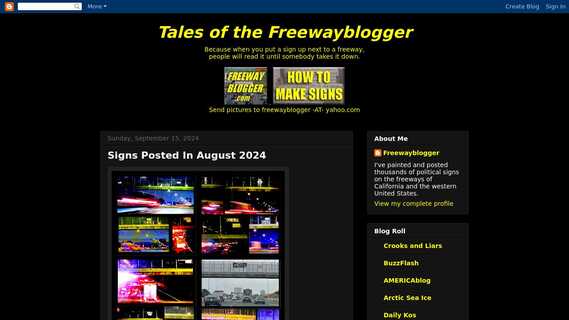
A group of free speech advocates who hang large signs on fences on public property in the US.