
Snapshot
People & organizations are more complicated than their stated positions. By peeling back the onion on both friend & foe, we can discover potential allies and reveal power- holders’ hidden conflicts of interest.
We are what we pretend to be, so we must be careful about what we pretend to be.
— Kurt Vonnegut Jr.

Origins
The onion tool was first developed by Ian Mitroff and Thierry Pauchant in the 1990s as a means of managing crises and conflicts, but its use has expanded to many different fields.
People — including politicians and other people with power — aren’t as one-dimensional as we might think. What they say isn’t always what they actually want or need. Rather, they have complex layers of needs, interests, and positions; some may be visible and others invisible. The onion tool helps us peel back their political rhetoric to build a deeper, more complex picture understanding of what motivates particular individuals in power, so we can better work with (or against) them.
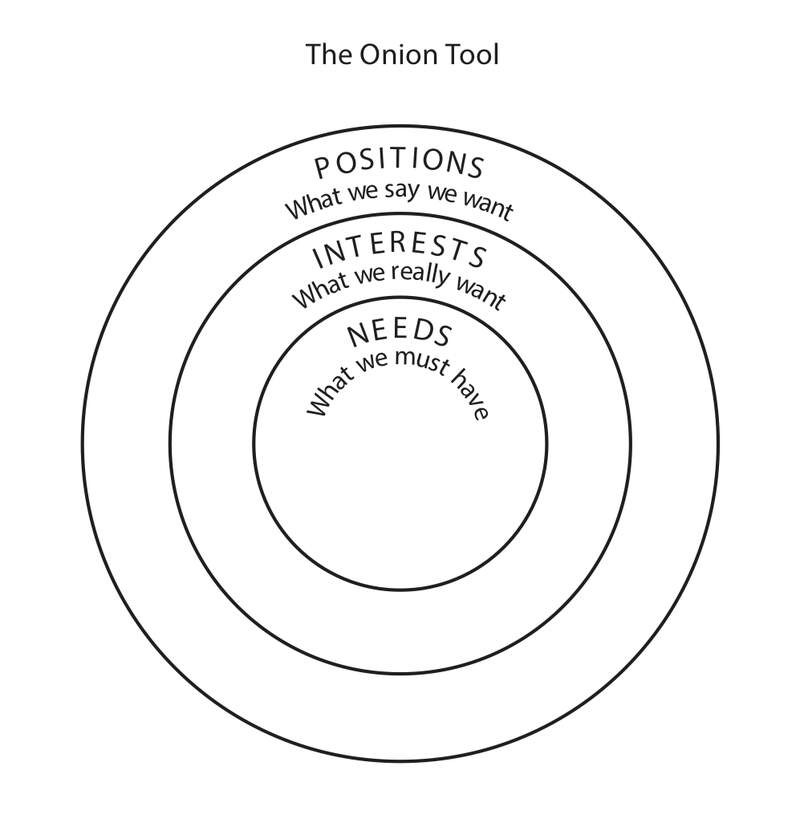
The onion tool makes a critical distinction between a powerful person’s positions, interests, and needs.
A position is what we say we want. But talk can be cheap, especially from powerful politicians and the business elite. If we assume they’re telling us the full truth, we will never get the broader picture. This does not mean we need to be generally distrustful, only that it is advisable to think clearly, rationally, and critically when listening to what the powerful say.
If we’re going to be strategic about changing society for the better, we need to assess and analyze the positions, interests, and needs of those with power.
An interest, on the other hand, is what we really want. Our interests are not always evident from our stated position. For example, the interest of a politician may be to consolidate power and increase wealth. The interest of Coca-Cola or Shell is most likely to accumulate financial gain at the expense of others. Meanwhile they’re talking about the good of the nation, and promising happiness to anyone who drinks Coca-Cola. There is a clear difference between what they say they want and what they really want.
At the heart of it all are our needs. This is what we must have and is often non-negotiable. For an individual it may be our values, commitments, beliefs, or ethics. It is the innermost layer and generally where we are most honest. It is, of course, deep inside and often hidden, so understanding the inner workings of other people is not always easy.
So what does all this have to do with activism and campaigning? Well, if we’re going to be strategic about changing society for the better, we need to assess and analyze the positions, interests, and needs of those with power. By understanding powerful individuals at a more profound level, we can choose our targets wisely, communicate with them more strategically (and when needed, diplomatically), and better identify conflicts of interests and potential alliances.
Also, while positions are generally public, true interests are not. Sometimes exposing your opponent's true interest can undermine their credibility, and move your cause closer to victory.
The ability to distinguish between what people say they want, what they really want, and what they can’t live without has many practical applications. For example, the onion tool is great for conflict management within teams of activists or campaigners when disagreements arise. It can help you identify what really matters to you and your colleagues and help you determine shared priorities.
Originally published in Beautiful Rising.

How to use
Draw three concentric circles.
In the outermost circle write “Positions,” in the middle circle write “Interests,” and in the innermost circle write “Needs.”
Select an individual to base the onion tool on. This will likely be the name of an individual stakeholder who is relevant to your work.
Identify their positions. What are they saying publicly? What do they say they want?
Identify their interests. Can you deduce their actual interests? What do they really want?
Identify their needs. What is it that they can’t live without? To what or whom is their innermost commitment?
You now have a better understanding of where the individual in question stands. Repeating the process for various stakeholders will help you ascertain whom to target and with whom you may be able to forge an alliance.
As your campaign evolves, you can use this tool neatly in tandem with the power mapping methodology, using the latter to identify key stakeholders, and the former to peel back each stakeholder’s layers of interests (see: METHODOLOGY: Power mapping).