
Snapshot
Cross-reference internal & external factors in order to identify potential campaign scenarios.
A goal without a plan is just a wish.
— Antoine de Saint-Exupery

Origins
The SWOT matrix was designed in the 1960s to help businesses and organizations plan strategically, and since then has been used by a wide range of other groups and individuals.
Planning a campaign? Need a way to assess your situation and your capacity to address it? The SWOT matrix can help you and your organization identify key factors in play. By carefully considering internal strengths and weaknesses, alongside external threats and opportunities, you can identify your “best case,” “missed opportunity,” “mobilization scenario,” and “worst case” options.
The SWOT Matrix can help you determine or clarify your strategic goals, identify challenges you may encounter, and develop an effective campaign strategy or action plan.
Let’s say you’re running an anti-corruption campaign. If a SWOT analysis reveals that an internal strength (you have large core of committed volunteers) overlaps with an external opportunity (a huge corruption scandal has just broken), you would potentially have the best case scenario of being able to field a large team to deliver information or materials to newly aware constituents. This could lead you to identify a need to develop materials and fundraise for their printing. If, however, you have a minimal staff and no trained volunteers (weakness) when a major corruption scandal has just broken (opportunity) this could be a “missed opportunity” scenario, meaning you may need to develop alternative ways to meet your goals. These are just a few examples of the sorts of insights a SWOT analysis can provide. With a fully completed matrix, other insights could lead you to different strategic conclusions.
You may notice that, depending on the situation, an organization’s strengths could also be similar to an organization’s weaknesses. For example, many volunteers can be a strength if you need them, and a weakness if they need extensive training you cannot provide. In the same way, a breaking scandal can be both an opportunity (it’s a chance to expand your campaign) and a threat (your target may suddenly see you as a greater risk, and lash out in new ways).
SWOT can work well in combination with other methodologies, particularly:
Pillars of power (see: METHODOLOGY: Pillars of power), to identify the key institutions that need to be included as external forces in the SWOT Matrix
Spectrum of allies (see: METHODOLOGY: Spectrum of allies), to help you identify and assess specific key parties, constituents, impacted communities, and opposition forces.
Force field analysis, to identify the relative strengths of forces acting to support the status quo, as well as what forces and actions might counter them.
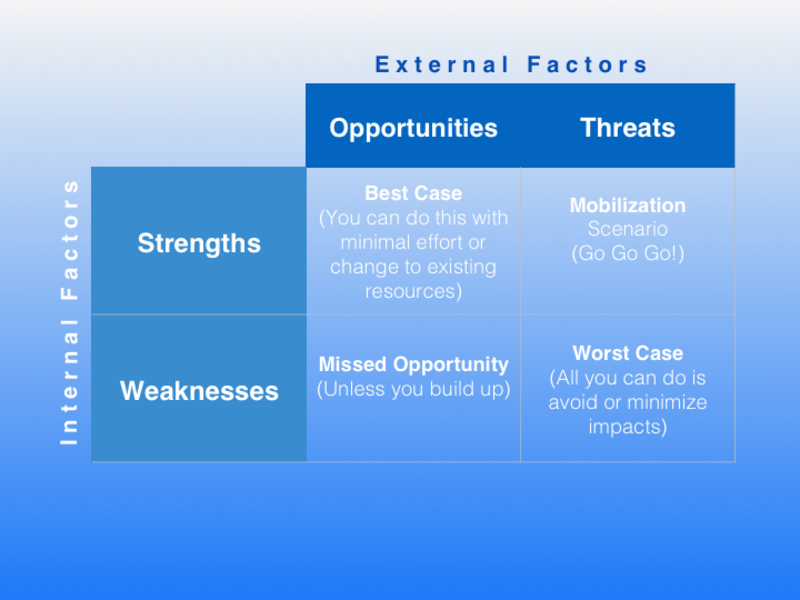
A SWOT matrix can help you clarify your strategic goals and your capacity to address them.
The SWOT matrix’s superpower is to help you determine or clarify your strategic goals, identify challenges you may encounter, and develop an effective campaign strategy or action plan.

How to use
Assemble the right team for the job: those with the knowledge of both the internal strengths and weaknesses, and the external threats and opportunities.
Using the matrix, first list out your internal “strengths” and “weaknesses,” then the external “threats” and “opportunities.” (Remember, some items could end up in more than one category!) If you are working with a large group, consider sketching the matrix on a large sheet and writing the SWOT items on sticky notes and then placing them in the appropriate boxes.
Now, take some time to figure out how your strengths and your opportunities intersect, and write down those ideas in the appropriate scenario box. Do this for the remaining scenario boxes (strengths and threats, weaknesses and opportunities, weaknesses and threats). Note that the ideas that come from the intersection of strengths and opportunities fall in the “best case” box, and could be considered “low-hanging fruit” — actions that could be done fairly easily, with minimal effort or expenditure of resources. Where weaknesses and opportunities intersect, you’ll find your potential “missed opportunities” — opportunities that are hard to act on unless you can overcome your shortcomings. Where strengths and threats overlap is a possible “mobilization scenario,” where you have potential to proactively meet the threat. Finally, where weaknesses and threats intersect you’ll find your “worst case” scenarios (where you end up in the “W.C.” ), which you should try to avoid if possible.
Use the scenarios to help you identify SMART (Specific, Measurable, Achievable, Realistic and Timely) goals as part of your strategic planning process.