

Snapshot
Breaking a law in public in order to challenge the moral legitimacy of that specific law (e.g. racial segregation) or a greater injustice committed by the state (e.g. corruption).
Civil disobedience is not our problem. Our problem is civil obedience.
— Howard Zinn
The greatest strength of social movements is often their capacity to disrupt. At its core, an act of civil disobedience is a disruption that expresses political opposition beyond what the law permits. In an act of civil disobedience, you either publicly break an unjust law in order to challenge the legitimacy of that law, or you commit some minor infraction (trespassing, for example, or obstruction), with the intent of bringing about broader political changes.
Civil disobedience can manifest in a number of different ways. Strikes, sit-ins or sit-downs, marches, and lockdowns, among many other tactics, can all be used as acts of civil disobedience.
Acts of civil disobedience can challenge not just a specific law, but also the very legitimacy of a state.
Because it seeks to awaken the conscience of society to some injustice, an act of civil disobedience should be carefully planned if it is to have maximum effect. Design your action so that it places your target in a decision dilemma or uses humour to undermine their authority. Be public about your intent, maintain nonviolent discipline, and be prepared to go to jail (see: TACTIC: Jail solidarity).
Though nonviolent resistance to injustice is as old as injustice itself (as the classic Greek tragedy Antigone tells us), the modern understanding of civil disobedience dates to Henry David Thoreau's book Civil Disobedience (1849). Thoreau argued that the individual has a right to resist government abuses and injustices, stating, "the only obligation which I have a right to assume is to do at any time what I think right.” He refused to pay his taxes because they were being used to expand slavery in the United States and wage a war against Mexico. A century later, Hannah Arendt argued that civil disobedience is integral to a democratic state, since only “extralegal action,” such as civil disobedience, can expand rights and justice beyond the existing limits of the law.
Acts of civil disobedience can challenge not just a specific law, but also the very legitimacy of a state — particularly a colonial or occupying power (see: THEORY: Decolonization). Indeed, one of the best known examples of civil disobedience is Gandhi's salt march from Ahmedabad to Dandi to make salt in violation of the wildly unpopular British salt laws, a campaign that played a key role in exposing the illegitimacy of British authority and ultimately led to India’s independence. This act of civil disobedience was brilliantly planned and strategically well thought-out. Gandhi crisscrossed the country for weeks, publicly announcing the impending “crime” and telling his fellow Indians that it was their duty to disobey British rule by marching with him. This put the British authorities in a decision dilemma: If they arrested the salty lawbreakers, it would spark even wider support for the movement and confirm the British rulers’ brutality. But if they didn't do anything, they would look as if they had lost the ability to enforce their own laws. Either way, British rule was doomed by Gandhi’s mass public violation of a simple law.
Originally published in Beautiful Rising.

Key principle
If participants in an act of civil disobedience become violent, you have already lost. The power of civil disobedience lies in a respect for a moral law that is more powerful than the state’s laws, and you need to hold the moral high ground (see: PRINCIPLE: Anger works best when you have the moral high ground). To be effective, you must ensure that everyone participating is committed to nonviolence during the action (see: THEORY: Strategic nonviolence). Otherwise, you will only bolster the legitimacy of the state, and give them an excuse to beat up the “common lawbreaker.” If you stay cool and disciplined, you will have a much higher chance of winning the respect and support of the public than if you don't (see: THEORY: Hamoq and hamas).
Real world examples
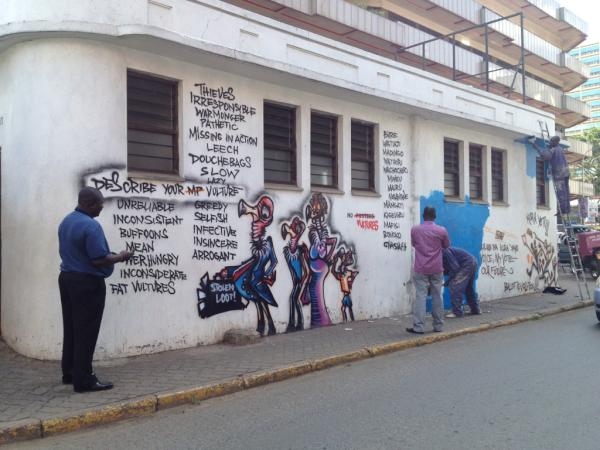
Strongly messaged political graffiti springs up overnight across Nairobi, sparking widespread public discourse.

Months-long protests over educational reform in Myanmar came to a head as police clashed with students marching toward the former capital.