

Snapshot
Turning anger into action is necessary, but that anger is most effective when it is disciplined and intelligently focused (hamas). Uncontrolled, stupid anger (hamoq) mostly undermines your own cause.

Origins
Hamza Yusuf, 2000s.
Readers: please note this piece refers to concepts defined in the Arabic language which can help us understand healthy use of anger in social movements. This piece is not about the political party by the same name.
The great Islamic activist Hamza Yusuf Hanson distinguishes between two forms of political action. He defines the Arabic word hamas as enthusiastic, but intelligent, anger. Hamoq means uncontrolled, stupid anger.
The Malays could not pronounce the Arabic letter “H”, and the British acquired the second word from them. On the streets of Genoa during the 2001 G8 summit, while the white overalls movement practiced hamas, seeking to rip down the fences around Genoa’s red zone but refusing to return the blows of the police, the black bloc ran amok.
The important thing about hamas is that, whether or not it is popular, it is comprehensible. People can see immediately what you are doing and why you are doing it.
Hamas explains itself. It is both a protest and an exposition of the reasons for that protest.
Hamoq, by contrast, leaves its spectators dumbfounded. Hamas may have demolished the McDonald’s in Whitehall, England, on May Day 2000, but it would have left the Portuguese restaurant and the souvenir shop beside it intact.
Hamas explains itself. It is a demonstration in both senses of the word: a protest and an exposition of the reasons for that protest. Hamoq, by contrast, seeks no public dialogue. Hamas is radical. Hamoq is reactionary.
If, like some of the black bloc warriors I have spoken to, you cannot accept this distinction, then look at how the police responded to these two very different species of anger.
On Friday, though they were armed to the teeth and greatly outnumbered the looters, the police stood by and watched as the black bloc rampaged around Brignole station, smashing every shopfront and overturning the residents’ cars. Then, on Saturday night, on the pretext of looking for the people who had caused the violence, the police raided the schools in which members of the nonviolent Genoa Social Forum were sleeping, and started beating them to a pulp before they could get out of their sleeping bags. The police, like almost everyone else in Genoa, knew perfectly well that the black bloc were, at the time, camped in a car park miles away.
It is not hard to see which faction Italy’s borderline-fascist state felt threatened by, and which faction it could accept and even encourage.
If Carlo Giuliani did not die in vain, it was because the Genoa Social Forum had so clearly articulated the case he may have been seeking to make. His hamoq forced a response because other people were practicing hamas.
Hamas instructs us to choose our enemies carefully. Indeed, when actions are clearly focused, then violence toward human beings is far less likely to take place, as it’s harder to forget what we are seeking to achieve.
Originally published in Beautiful Trouble.
Real world examples
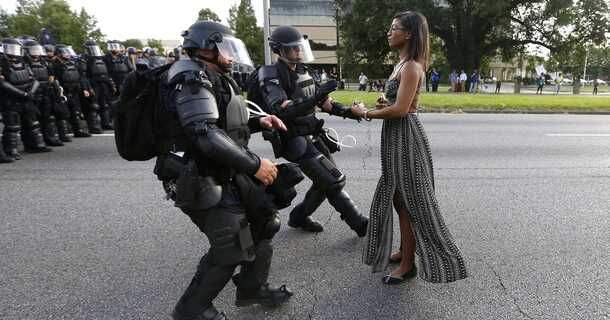
The story behind the female protester who stood her ground against Baton Rouge police officers during a Black Lives Matter protest.