
Snapshot
A large community gathering to discuss important matters, share information, & hold leaders to account.
The little grassroots people can change the world.
— Wangari Maathai

Origins
Baraza is a Swahili word for large community gatherings that have been part of the fabric of village life in East Africa long before European colonization. Similar gatherings happen under other names in a variety of forms around the world, especially in the Global South.
A baraza is a large community gathering to discuss important matters, share information, and hold leaders to account.
Especially when employed in rural areas of East Africa, barazas often attract hundreds — or even thousands — of local residents. Movements and organizations are able to tap into these spaces to bring forward critical issues, say, educating people on mitigating the effects of climate change, calling attention to rises in domestic violence, or exposing a corrupt local leader.
Barazas are a quite horizontal, and directly democratic, mechanism for community organizing.
Incompetent civil servants, greedy businesspeople, and dishonest politicians usually refuse to show up at barazas, for fear of being shamed for their actions. Wrongdoers who are brave enough to appear are forced to make amends for their transgressions.
Barazas are not always a battle of good versus evil. Often a problem affecting a community is raised for discussion, and solutions are gathered from attendees. When agreed upon, responsibilities are designated to particular teams to implement. In this way, barazas are a quite horizontal, and directly democratic, mechanism for community organizing.
In Abim, Uganda, barazas were used to evaluate civil servants on how responsibly they used local tax revenues. This resulted in improved infrastructure, including roads and bridges.
The Constitutional Movement in Kuwait from 1986 to 1992 employed the use of diwanyat — annexes to homes where local assemblies are held — to organize while street protests were illegal. Due to cultural norms, police would never enter a diwanya. Diwanyat enabled mass mobilization, fueling a movement that eventually attained the reinstatement of the suspended constitution.
Humans everywhere have organized baraza-like gatherings under various names: “town halls” in New England, “indignados” in Madrid, “diwaniyat” in much of the Arab world. One might argue the baraza is fundamental to the human way of being, filling a need to come together and belong while working toward a better community.
What is the baraza of your culture? What is the naturally existing direct-democratic tradition in your community? And how can you harness it to improve things?

How to use
Barazas are organized differently, and under various names, depending on the context. A few basic steps to organizing them usually apply:
Prepare. A coordinating team determines the time, location, and agenda of the baraza.
Announce. Members of the public are notified. In rural parts of collectivist societies, a bulletin is tacked to a tree, notice board, or central place; that, plus word of mouth is generally enough to ensure adequate turnout. Common practices elsewhere include creating Facebook events, and sending announcements home to parents of school children.
Convene. Hold the baraza. It’s generally wise to assume that those who have shown up are the ones interested enough to offer their time, and rely on their participation. Facilitation of a baraza is not so intensive, as it relies on the discussion and input of attendees, but it is useful to have a general outline of your agenda.
Continue. If relevant, inform participants of the next baraza’s time and location, and encourage them to invite others.
Real world examples
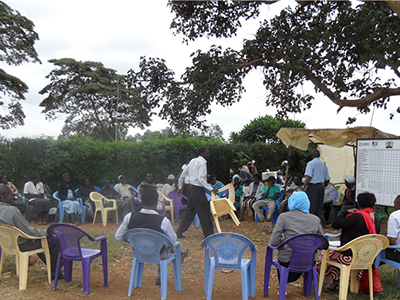
NGOs and government programs organized community meetings on the topic of public sanitation.