

Snapshot
Feminist social movements identify patriarchal power as a fundamental source of injustice and inequality, and hence call to transform gender power relations in all domains.
I am not free while any woman is unfree, even when her shackles are very different from my own.
— Audre Lorde

Origins
Though the history of feminism tends to be divided into phases or “waves” starting in the 19th century, movements for women’s rights and gender equality stretch back much further, manifesting in many different ways across different cultures.
In thinking about feminism, it is essential to start neither from fear nor fantasy. While fear stems from the belief that feminism is anti-male, fantasy is the belief that feminism is easily attainable.
Feminism is a social movement that challenges a system of sexist oppression — called patriarchy — that is deeply entrenched in many societies and into which we are all born. Feminism aims to eliminate all forms of discrimination against women, including those related to sex and gender as well as class, race, ethnicity, ability, sexual orientation, and other forms of exclusion. This movement of resistance is often met with violence, stigmatization, and condemnation because it seeks to deconstruct an oppressive power structure, thereby challenging those that benefit from it.
The story of the Miniskirt March is a clear manifestation of this theory in action (see: STORY: Miniskirt March). In response to recurrent incidents of violence, harassment, and stigmatization against women’s choice of clothing, women and human rights activists organized a march wearing miniskirts and tight-fitting clothes and paraded the streets of Harare in protest. Although the march was met with mixed reactions from the general public, it disrupted an otherwise banal power structure.
In this sense, challenging patriarchy involves challenging our privileges, our prejudices, and ourselves.
Feminisms are diverse in origin and expression. Generally, though, they analyse and challenge patriarchal power as well as other systems of privilege and subordination. Feminisms have evolved over time from making linkages between slavery and women’s bondage to focusing on women’s subordination in the private sphere, including matters such as bodily autonomy, sexuality, and gender-based violence. In more recent times feminism has become more expansive, involving greater diversity across generations, classes, ethnicities, and sexual orientations.
Given that the vast majority of people are born into a world full of bias, be it gender, class, race, or nationality, we have all been largely shaped by patriarchy and often play into it in unconscious ways. Feminism seeks to create a critical political consciousness that enables people to identify injustices and challenge them. In this sense, challenging patriarchy involves challenging our privileges, our prejudices, and ourselves. Thus, we should always be sure that our gender-consciousness — our efforts to challenge the implicit oppression within us — becomes a way of seeing and living, and is implemented in other struggles for social change (see: PRINCIPLE: Challenge patriarchy as you organize).
Feminism is not something one is born into; it is a political act and a choice to be feminist. This choice is then manifested through one’s actions. The success of feminist organizing in challenging complex systems of power thrives on creating an environment where revolutionary feminist consciousness can be cultivated, without reproducing the same problems that dominant systems create to begin with (see: THEORY: Anti-oppression).
The goal of feminist organizing is for all people, regardless of their gender or their sexuality, to live fully as who they are in a world that is peaceful and abundant with possibilities.
Feminism is about recognizing that all oppressions intersect. As Audre Lorde says, “I am not free while any woman is unfree, even when her shackles are very different from my own.”
Originally published in Beautiful Rising.
Real world examples
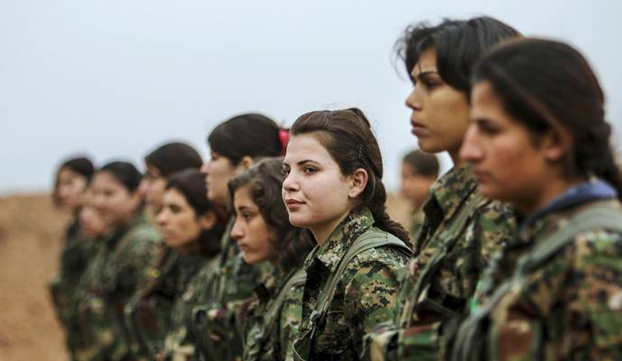
Media sources often failed to go beyond images of female soldiers in understanding what feminism means for Rojava.