

Snapshot
Art seeks to explore deep questions. Politics demands a clear direction and message. The right balance can move both hearts and minds.
Art is not a mirror held up to reality, but a hammer with which to shape it.
— Bertolt Brecht
“Political art.” Easy to say, harder to do. Art seeks to explore the deep questions. Politics demands a clear direction and message. That’s a tough tension to manage. Sometimes quick gimmicks are called for; sometimes it pays to dig deeper — in our craft and in ourselves — to mobilize the unique powers of art.
“If I could tell you what it meant,” Martha Graham once said, “there would be no point in dancing it.” Unlike politics, which tends toward plain prose in endless repetition, art goes beyond explicit meanings to connect with that more elusive, soulful dimension of being human — a realm which must be engaged if we are to truly change the world (see: THEORY: Ethical spectacle).
Art invites us to think rather than telling us what to think.
Song has its own special powers. Singing together builds emotional ties and harmonies — literally and figuratively. Song makes us feel powerful and united in a way nothing else can. During the breakup of the Soviet Union in 1989, the Estonian liberation movement used the country’s traditional songs in resistance work. At one juncture, a full quarter of the country’s population sang together in the streets, facing down Soviet tanks.
Consider the power of Picasso’s Guernica. A striking and visceral canvas painted in protest of the first aerial bombing of civilians, its aura as a global symbol of the senseless devastation of war was still strong enough seventy years later that the Bush Administration felt compelled to throw a cloth over a tapestry copy of it when Colin Powell spoke at the UN pushing for war with Iraq. Images from Guernica continue to resurface in anti-war marches the world over.
Advertising is the dominant art form of capitalism, as well as a science of messaging. In the late 1980’s Gran Fury, an AIDS activist art collective, used the artistic and messaging power of graphics to bring the AIDS epidemic front and center and move a critical social conversation in a direction it had never gone before. Their “Kissing Doesn’t Kill: Greed and Indifference Do” bus ads featuring same- and mixed-sex couples kissing were not only explicit in their visual content, but beautiful, hip, emotive, and evocative.
Art invites us to think rather than telling us what to think. This is one of its great powers, and if you make your art accessible and beautiful enough, people will want to follow where it goes. And because they themselves are deciding where to go with it, they’ll more easily connect it to their own experience.
The right balance of art and message can move both hearts and minds. Striking this balance, however, can be difficult. Think about your audience and your goals. What do you want your art to achieve? Do you want to evoke sympathy? Provoke deep soul-searching? Get people to call their Senator? Art can help you do all of these things, but only when art and message are in balance. You know you’ve struck gold when you’re able to say something so clearly that it hardly needs to be said at all, but is instead embodied in how you’ve said it.
Originally published in Beautiful Trouble.
Real world examples
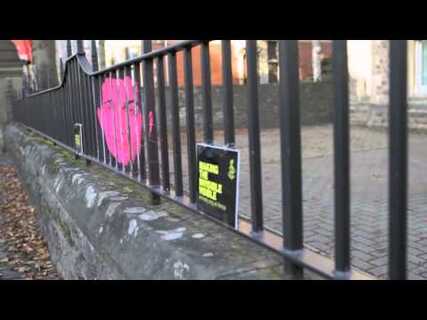
A beautiful Amnesty International street art project highlighting the plight of six individuals who have suffered human rights abuses.
This 2002 documentary film that depicts the use of music in the struggle against apartheid in South Africa.
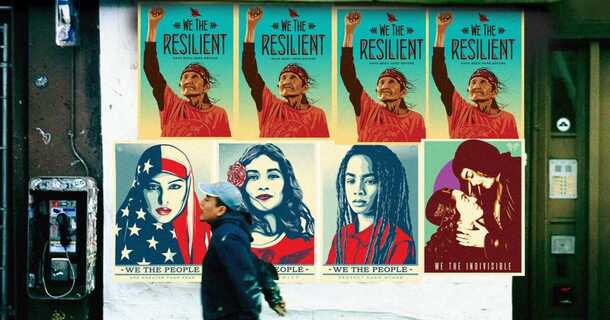
Shepard Fairey explains his 'We the People' inauguration protest posters.