

Snapshot
Some people only work through the system. Others only challenge it from outside. But the most powerful strategies will link the two, combining social movement pressure with efforts to win and wield state power.
Much as armies use both foot soldiers and armored vehicles, progressives must also leverage the full capacities of their diverse forces. If a movement can deploy both advocates and disruptors, both politicos and protestors, a powerful and unified inside-outside strategy is within grasp.
Insiders slowly work their way through official channels, seeking to capture, or at least leverage, state power. They see compromise as the price of entry, and disruption as a threat to their painstaking efforts.
Outsiders reject compromise and patience, staying true to the radical demands that fuel social movements. To outsiders, the efforts of insiders seem divorced from people’s immediate needs and too sluggish to create meaningful change now.
Wise organizers won’t abandon institutional politics altogether; they also won’t cut themselves off from outsider social movements.
Sometimes, one of the two opposing strategies breaks down. “Told you so,” say outsiders with triumphant glee, whenever an insider is exposed as a sellout. “Here we go again,” gripe insiders, rolling their eyes, whenever outsiders waste the energy and enthusiasm of the people without achieving any tangible change.
Disappointment by either side may lead to an exaggerated swing of the pendulum to the opposite method. A widespread perception that institutional change had failed culminated in the 1968 student rebellion in West Germany, as the Sponti Movement rejected institutional politics, preferring "revolutionary spontaneity of the masses." When that uprising, in turn, failed to generate the promised change, Rudi Dutschke argued that such change could be brought about only by a "long march through the institutions.” In the end, one of the Spontis, Joschka Fischer, became a minister in the German government. From inside strategy to outside strategy and back to inside strategy, the pendulum had made a full swing.
Wise organizers won’t abandon institutional politics altogether; they also won’t cut themselves off from outsider social movements. Understanding the importance of each component of a unified strategy will prevent disappointment and build campaigns that make use of both, increasing the likelihood of achieving real gains.
Protest and disruption are not just a pressure valve; they should, in the words of Martin Luther King, “create a situation so crisis-packed that it will inevitably open the door to negotiation” (see: PRINCIPLE: Build people power, then negotiate).
On the other hand, negotiation is not the end of mobilization, as shown by the negotiating style of Lech Walesa during the 1981 strike at the Gdansk Shipyard in Poland. While negotiating with the government, he kept constant communication with the members of the Solidarity trade union and addressed them regularly. “Solidarity cannot give a carte blanche guarantee to the government until it knows what the government's intentions are,” he kept assuring the strikers.
But rarely does one act as both negotiator and mobilizer. Insiders and outsiders usually work apart. They can prevent discord and work in unison with the help of three special ingredients: coordination, communication, and trust. Coordination implies that both inside and outside components of the overall strategy are in sync. Communication means that at every moment negotiators know what is happening in the street and organizers know what is happening in the room. Trust between insiders and outsiders is the glue that will keep both components of the strategy together when coordination falls out of sync and communication breaks down.
With these three ingredients and a nuanced understanding of power, movements can create change through an inside-outside strategy.
Real world examples
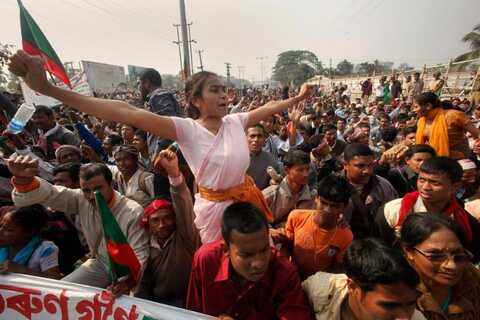
The ability of the Pakistani lawyers to strategically organize was central to the movement’s success.

An interview with Oscar Olivera