
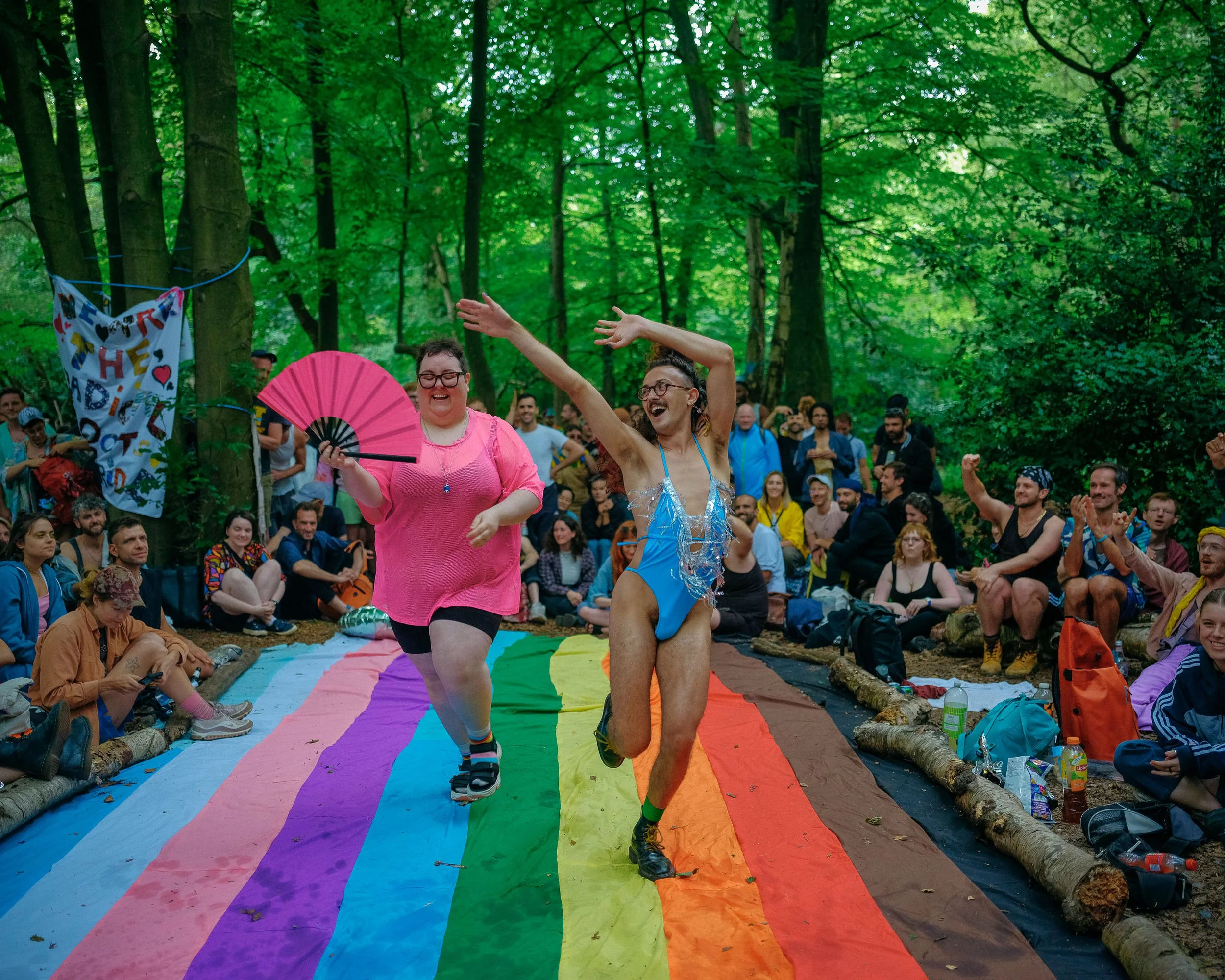
Scenes from (Fuck Off) This Is My Culture 7 in 2023 - Used with permission from ACT UP LondonBeautiful Trouble’s Get Up, Rise Up! fund, a microgrant program that provides support to grassroots groups using creative nonviolent action to challenge injustice and build people power, helped support this year’s installment of This Is My Culture in London. We had a chat with fellow troublemaker Dan Glass who helped organize this outrageous action and unpack its history. What resulted was an interview of cross-movement collaboration and creative inspiration…
Can you tell us about This is my Culture?
For a decade now, annual This is my Culture protest-parties have celebrated the revolutionary, unapologetic queerness of George Michael and his incredible legacy of sexual freedom, defiance, wit, and hilarity. The party is named after the moment George was taking a late-night stroll on Hampstead Heath — where cruising has taken place since at least the 19th century — when he was ambushed by a tabloid photographer and responded with, “Are you gay? No? Then fuck off, this is my culture!”
This was just one example of how George Michael helped millions to re-evaluate and transform how they saw and embraced sexuality. A unique combination of music, protest, rave and queer culture, the event draws on revolutionary union organizing, militant AIDS activism, reclamation of public space, radical faery ecological-spiritually, and, most of all, a love for the wit and legacy of George Michael.
We also drew on the international Radical Faerie tradition, which blends spirituality, performance, activism, and sexual freedom. Our parties borrow from pagan rituals, rave culture, protest tactics, and queer cabaret—creating a hybrid form of cultural defiance that builds alliances in the arts and activist communities.
Can you talk a bit about the importance of ‘cruising’ as a tool in the beautiful troublemakers’ toolkit?
Cruising and protesting are both vital and enduring parts of LGBTQ+ culture. Cruising culture isn’t solely for sexual pleasure, it has been an age-old enlightened response to a fascist environment. A lack of safe spaces means alternatives are a necessity if you want to get your rightful sexual kicks.
From this necessity, “cruising” became a much-desired, enjoyable and often super-hot sexual practice. From the need, also grew the want—and still does.
Also, with the dismantling and removal of so many queer spaces and the rise of homophobic regimes, it is no wonder that queer public sex is on the rise once again. When bigotry strikes queer culture, we all need to push back, because these attacks tend to spread to other vulnerable communities—anyone outside the confines of dominator culture poses a threat to maintaining the status quo of order, control, and power.
George’s reclamation of queer culture and art was a love letter to the queer experience. His “Outside” song, his lyrics and his lived experience all offered a counter-narrative to shame and an embrace of radical joy (see PRINCIPLE: Joy is a revolutionary force). He turned grief into gospel, humiliation into pride. This is why we stubbornly refuse to comply with Hampstead Heath’s police bylaws. George would be turning in his grave if we asked permission from the police.
From Club Tropicana to Mother’s Pride, financing Hyde Park AIDS vigils to Hampstead Heath standoffs in the press, George lived and died for a world where no one had to apologise for who they were. As new generations face old battles, This is My Culture calls on artists, activists and fans alike to embody George’s audacity. How do we honour his spirit? By making noise. By dancing in protest. By choosing life—not as nostalgia, but as resistance.
Can you tell us about how the idea for the “This is My Culture” festival emerged?
Sitting in a London pub with a few friends on Christmas Day 2016, grieving the death of George Michael, a legend, faggot, and unapologetic symbol of sexual freedom, we asked ourselves:
How do we honour someone who gave us the language of liberation?
Our goal was to reclaim public space for queer joy, resist the erasure of queer cruising culture and celebrate the radical, sexy, loud legacy of George Michael. We wanted to create an ongoing space that was simultaneously celebration and protest: a fuck-you to assimilation and a love letter to our culture.
So now almost ten years on, can you describe what someone participating in
“This is My Culture” might experience?
We throw a party. But not just any party. We turn a public space into a living, breathing declaration of cultural autonomy. The music is ours. The outfits, the rituals, the laughter, the defiance—all ours (see TACTIC: Reclaim the streets). We dance under banners that read “Fuck off, This is My Culture.” DJs play beats that are banned in certain venues. Elders speak. Youths shout. Each year, the event opens with speeches by activist elders and fundraising for movements for LGBTQIA+ liberation.
Cops come by, unsure how to respond. But we are prepared. Our cultural expression isn’t illegal—just inconvenient for those who want our culture without our politics. The media show up. Social media explodes. People who previously felt unseen, unheard, erased, see themselves reflected in our action. And it all takes place around Hampstead Heath’s infamous “Fuck Tree,” one of George’s favourite cruising spots.
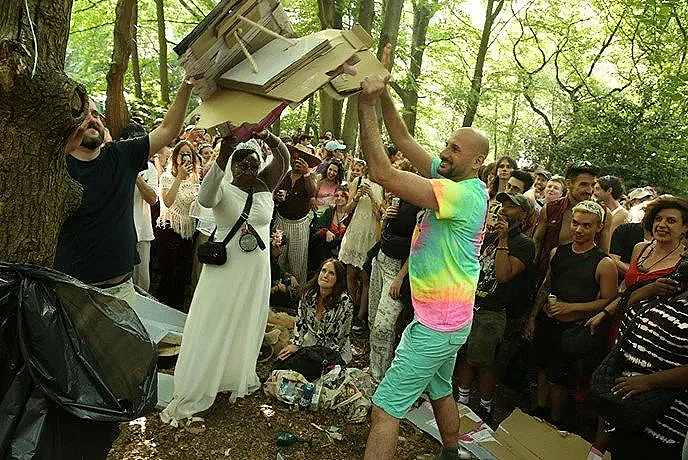
We pick up our placards:
“I’m dancing with the freaks.”
“Freedom! I will not give you up.”
“I want your sex. I want you. I want your sex.”
Then the party truly begins: oil wrestling, fashion runways, piñatas of our nemeses Margaret Thatcher or Winston Churchill, and ecstatic dancing in nature.
It is joyous, furious and deeply rooted in love.
Party goers smash a Tesla pinata. - Image by @mvpicsss
That sounds amazing. Then what?
The party ends when we choose to end it—leaving the forest a little more magical than we found it. But the impact has rippled far beyond that one day. With all our sweat, cum and tears - we show that resistance can look like joy, that culture can be weaponised for liberation.
“This Is My Culture” has become a touchstone for a generation unafraid to be unrespectable. It sparked an unapologetic reclaiming of culture by people who’d had enough of being curated, diluted or ignored. The message remains: We don’t need permission to exist. This Is Our Culture—and we are doing it on our terms. And every time we gather, fuck and dance, we tell the world:
Our joy is sacred. Our sex is sacred. Our culture is not anyone’s to police.
Can you say a bit about the political context “This is My Culture” grows out of,
or in resistance to?
The United Kingdom has a long tradition of both state repression and queer resistance—from the Gay Liberation Front to ACT UP, Lesbian Avengers, OutRage! to Section 28 protests and Trans Pride. Hampstead Heath has itself been a key site in queer sexual history, and every year the police come to This is My Culture for their annual lesson in how our Patron Saint George Michael defied homophobic police and institutional violence with unapologetic sass, pride, and dignity and why we will continue to do just that.
Every year has a specific song theme and political theme. In 2024, our demands centred the ongoing genocide in Palestine, an homage to George Michael’s anti-war advocacy, demanding an end to British weapons deals with Israel. In response, police have been building a concerted effort to shut us down by taking a much more aggressive approach.
In 2025, we focused our energy on Trans Liberation. The UK government continues to criminalize queerness through anti-trans narratives, funding cuts, and residual Section 28-era moralism. When posters appeared on the Heath in 2025 urging dog walkers to “reclaim” it from cruisers, the right-wing media seized on it. But we weren’t backing down. Instead, as part of This is My Culture, we launched “The Sodomites’ Walk”—a cheeky, proud march of queer bodies reclaiming the Heath with bared bums and brilliant signs. The Daily Mail was scandalized. We were delighted. We showed that sexual freedom is not shameful—it’s culture, resistance, and community.
And where would you locate “This is My Culture” within the broader history of queer activism, pride, and resistance?
Pride has continuously been corporatized and militarized, and too many people believe the only way to challenge institutional homophobia is by being marched from A to B by the very institutions, the police, that oppress us. There have been many calls for reform, dialogue, or inclusion, but little meaningful change. So we decided to shift the strategy from negotiation to embodied confrontation— with culture-as-direct-action.
“Legitimacy” is often awarded to those who conform to a sanitized, apolitical version of identity. This is My Culture’s approach—raw, loud, explicitly political—means we are deliberately stepping outside that system. We choose not to seek permission. We ain’t asking to be included—we are claiming space.
Do you have any insights for other organizers regarding why This is My Culture has been such a success?
At This is My Culture, sex positivity and queer justice can go hand-in-hand—centering pleasure while pushing back against the restrictive norms of patriarchy, heteronormativity and capitalism. This blending of celebration and resistance underscores the importance of pushing against respectability politics in order to preserve the rituals that make queer culture unique. As one partygoer remarked, “everyone is super alert and caring and attentive—moments that can embody the future we demand. The cops felt it too, we joined arms and they had to back off.”
Any cautions, lessons learned, or failures that organizers of similar events should be
aware of?
The police rely on intimidation, fear and divide-and-rule, so we have to build a continuous series of “know your legal rights” training to empower our community, as some organizers and attendees can become fearful. This is not a failure, just a reality of challenging institutional oppression.
As lead defendant on the Mitting Undercover Policing Inquiry, I know all too well the personal cost of police malfeasance, so that is why it’s important for people to stand up to the police, stand their ground, and build the base consciousness and strength to resist the police going forward. Hopefully, This is My Culture is a flashpoint where a radical queer identity that draws upon our rich revolutionary legacy can continue to renew itself.
Dan Glass is an O.G. troublemaker, a longstanding Beautiful Trouble collaborator, and the focus of a film called, of course, Beautiful Trouble.
A few Beautiful Trouble concepts that This is My Culture embodies:
Tactic: Artistic vigil
Artistic vigils have long been at the heart of HIV and LGBTQIA+ culture, for better or for worse. The spiritual and political importance of claiming space and continuity with a history of queer struggle, amplifying the ACT UP mantra to remember the dead to fight like hell for the living holds space to remember a whole beautiful generation murdered because of ignorance, bigotry, pharmaceutical greed, and government inaction over those slain in the AIDS genocide. George lost his partner to AIDS complications due to government inaction and pharmaceutical greed, and countless of our community still die due to emboldened government bigotry and internalized stigma. Our banners at the centre of This is My Culture, as we open the ceremony, serve as a renewed version of the AIDS Quilt, and the memories, grief and stories shared of lost loved ones lay the foundations for the dance we all deserve.
Principle: Balance art and message
Can a party also be a protest?
Can raves continue to defy authority in the age of relentless elitist enclosure of space?
Can parties commit to building queer utopia by leading from those on the sharp end of the knife of discrimination?
Is there a way that you can call-in the queer ancestors in the middle of LOUD, BANGING BRILLIANT DJ sets?
And how many naked oiled up bodies can you fit in one paddling pool?
Balancing the Art and Message of This Is My Culture, the hype and the substance is a continuous weaving process that happens within and between each year. As a direct action party, it’s so powerful getting party kids, ravers and old school activists in the same space. This rejects the either/or logic where politicized spaces and pleasure-seeking activists are necessarily kept separate. It's politicizing, deeply empowering, spiritual and liberating.
Theory: Prefigurative politics
This Is My Culture challenges us to create our dream in the here and now, a world where there are no barriers to sexual, social, and healthcare freedom.
Methodology: Spectrum of allies
This is My Culture is a melting pot that brings a broad church together, all expanding horizons and relationships spearheaded by George Michael’s unapologetic sassiness and defiance against police attacks on sexual freedom.